Viewing post categorized under: Uncategorised


“ As the primitive character of our relationship with God moves on to more mature levels, we may still get lost from time to time, in the details of life, or as one poet put it. The dust of the world.”
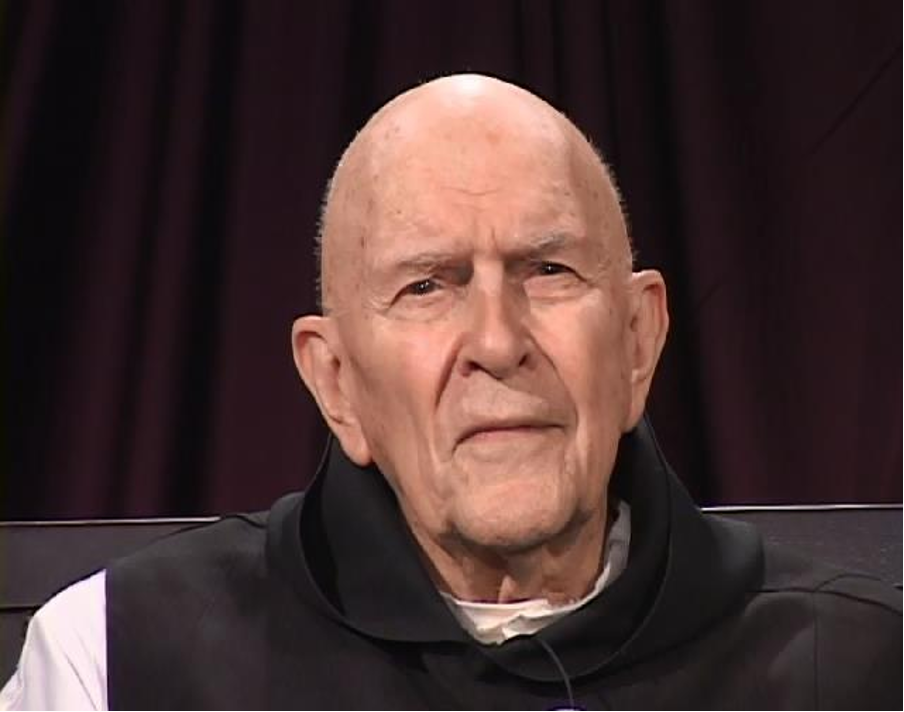
Thomas Keating”

 Thomas Keating’s Experiment extracts from an article written in 1993
 
Continuation from the last Newsletter of the article written by Thomas Keating on 6/6/ 1993.
 

“The term, “meditation” means for people exposed to Eastern methods what we Christian mean by contemplation, that is, a way of disregarding the usual flow of thoughts for a certain period of time. From a physiological/psychological point of view, which is really the essence of any form of Eastern meditation. As Carlos Castenada put it in a classic phrase, “Stop the interior dialogue.” That is the principal discipline in contemplative prayer. The process of committing oneself to the Divine guidance is not a “hands -on” feeling quite the contrary, it is the courage to proceed without any divine “hands-on, that is, into the dark nights where the real journey takes place, and without  which one does not normally reach the Promised Land.
 
Our organisation is definitely not a form of lay monastic life. I deliberately rejected that paradigm because I knew as soon as we used the term “monastic,” the average citizen would be back in the institutionalized view of contemplation which is for cloistered people only. Even more secular priests have the same concept. I remember a priest saying that in the seminary he attended, when the professor of spirituality came to the place where the text referred to contemplation, he said, “We won’t go into that stuff here. That is for the boys up in “*Spencer”

As if contemplation had nothing to do with persons in active ministry. That was the mindset that we were dealing with until 1975. One could not talk about contemplation even to cloistered people without some getting up and leaving or with most becoming very nervous. The rank and file were taught that this is only for mystics and saints. In actual fact, contemplation is not the reward of virtuous life; it is a necessity for a virtuous life. We will be waiting a long time for the priests and for the lay people who are now assuming many of the duties of priests, to be capable of spiritual guidance. They have to be touched or enlightened by the fact that we do not make ourselves spiritual directors but commit, submit, and surrender ourselves to the journey without the props that we would like to have to feel secure. In fact, the letting go of security is something we have to agree to. Without having accepted the trip into the unknown, one is really not a candidate for contemplation because that is what is presupposed: to let God lead us into a place that involves a complete reversal of our prepacked values, a complete undoing of all our plans, and a lot of  letting go of our preconceived ideas.

That raises the problem of what is self? What “self” are we talking about? This has given rise to the background material on the false self and the true self, which is basically the same ideas as the term “old man” and the “new man” in St. Paul.
 
Motivation is everything in the spiritual journey. God, I think, cares less about a change of lifestyle, monasteries, deserts, or perfect circumstances, than about our attitude towards what we are doing. As we know, our motivation can be inspired by the false self-system dressed up in religious or spiritual garb.
This letting going to the unknown, or other images for submitting to the unloading process, such as the idea of the divine therapy, is an essential step into the mystery of our own unconscious. Hidden there is not only our whole life’s history, especially the emotional wounds of early childhood buried in the warehouse of our bodies, but also the positive elements of our potential for growth in faith, hope, and love, and where the greatest repression of all, namely the Divine Indwelling, is also present.

We must gradually recover the conviction, not just the feeling, of the Divine Indwelling, the realization that God: Father, Son and Spirit, is living in us and that we are incorporated into the Trinitarian life and love, this is the heart of the spiritual journey and in service of which Centering Prayer is a renewal, a  way of making available the traditional teaching of the centuries in a form that is accessible to people today. This cannot be done, it seems to me, without some psychological relating since that knowledge is such a prominent part of Western culture.

The question arises “Is Centering Prayer a part of Lectio Divina?” It is not. It is related to Lectio Divina very closely but not so much to the method as to the developing relationship with Christ that Lectio Divina involves. It is emerging out of the same tradition. My experience in the monastery where Lectio Divina is the chief discipline of prayer, is that for years people would be reading scripture and other spiritual books with a certain prayerful intention, but they did not  know how to do Lectio in a way to foster its purpose as a relationship.
The primary purpose of the Centering Prayer practice is to rescue Lectio Divina from its failure in our time because people are enculturated to oppose its spontaneous movement toward contemplative prayer. There is little instruction in how to read a spiritual book and the obstacles to it be increasing with the information explosion. I observe this often in monks and nuns and other people. Some people have a bright mind and are intellectually geared to endless reflection.

This is not to say that some reflection on the truths of faith is not necessary. The great problem with Lectio in our time, is how do you get from simplified affective prayer to contemplation? I do not see many monks and nuns making that passage through the practice of Lectio. That is why I could see that Centering Prayer, or some such practice was essential even to do Lectio in the right way. In our time there is a predominant enculturation, especially in theological circles, in the two things that are most inimical to proceeding from discursive meditation to interior silence, and these are hyperactivity – thinking that we have to do something in prayer to please God. People think if their minds are empty of reflections or particular acts that they are doing nothing or dozing. The other problem is the tendency to over-conceptualize, a special hazard for those who are highly educated and more so, for those who are highly trained theologically.

They have gradually absorbed the idea that thinking about God is praying. It is not. Centering Prayer is a way of enabling people of our time to get over those two major cultural obstacles to their development in prayer. In Lectio we have reading, reflecting, and responding, and then in some mysterious fashion, resting in God. I did not see many monks and nuns doing the latter. For centuries in Jesuit communities for fear of false mysticism, one had to stick to discursive meditation. There is no common teaching in our time, as to how one moves from discursive meditation to resting in God. The historical results of this mentality is not surprising: contemplation became institutionalized and hence available only in certain highly structured circumstances, which were not remotely accessible to lay persons or even to those in the act ministry, not to mention busy monks and nuns in cloisters.  Without the experience of resting in God, all the capital sins can flourish without one actually being aware of the fact. One may think one is doing great things for God if one gets into parochial work or teaching, but the seven capital sins, the result of the emotional programs for happiness, are there in concrete form.
 
Centering Prayer is a distinct method of prayer. It is not Lectio in any sense of the term. But it is designed to rescue Lectio from stagnation and from its tendency to get stuck in interior ego
trips of one kind or another. At some point, people once they have thought over the truths of faith adequately, will not be satisfied with continuing to ruminate forever.
 
This is the reason why I say one cannot do the spiritual life nowadays without some knowledge of psychology. This is not to say that psychology will get you there. It will not. It will only clear the stage and enable one to get some degree of egoic self-identity, which still implies the false self in some degree. But without developing the ego or self-identity, the psychological resources for the journey are lacking. ….
 
Without  personal responsibility for our emotional life, however bad it is, the journey is not not going to be comprehensive or adequate. It is not our conscious life that is the biggest problem; it is the unconscious motivation that has to be changed.
 
Centering Prayer creates the atmosphere in which that change can begin to take place.
To be continued
 
 *Spencer referes to the Cistercian Monastery in Massettusets, USA
MONDAY AFTERNOON Weekly.
Every Monday at 3pm. Twenty minutes of Centering Prayer followed by a time for sharing and discussion. Normally finishes by 3:40pm. To participate send an email to: 
Hugh Reid at hugh_reid2@yahoo.co.uk
 
 
WEDNESDAY MORNING fortnightly
Wednesday Meeting
Fortnightly on Wednesdays at 11 am. Twenty minutes of Centering Prayer then space to share for those who wish until 11:45 am. 
Contact Elaine at: elainewatson387@yahoo.co.uk
 
 
WEDNESDAY AFTERNOONS fortnightly
Fortnightly on Wednesdays from 3:30 to 4:30. Twenty minutes Centering Prayer
Followed by a discussion based on a chapter from Thomas Keating’s book, “Open Mind: Open Heart.” To participate send an e-mail to David McCormick at davidfrancistssf@gmail.com
 
 
THURSDAY EVENING
Fortnightly on Thursdays from 7 pm till 8 pm. Twenty minutes of Centering Prayer followed by a discussion based on a chapter from Thomas Keating’s book ‘Open Mind, Open Heart’. To participate send an email to David McCormick at davidfrancistssf@gmail.com

A new page on the website contemplativeoutreachuk.com called “Calendar” will keep you updated on Zoom Groups and Events.

Contemplative Outreach Retreats 2022  
1. A Deeper look at Centering Prayer and its Transformative Action. 
The Franciscan Friars, Alnmouth, near Alnwick, 
Mon.8th  to  Friday 12th August 2022.
Costs:£210. Dep £25 to secure your place. Places going fast! 
 
2. An Intensive Retreat The Monastery of  Our Lady of Hyning.
Carnforth, near Lancaster. 
Friday 4th to Saturday 12 November. 
Costs £440. Dep. £25 to secure a place.
 
Cheques payable to Contemplative Outreach UK and sent to.
10 Hawthorne Ave; Higher Walton; PRESTON; PR5 4EE.
 
or bank transfer to:
HSBC,
Account:84444108
sort code: 40-37-25 Ref: Aln. Retreat.
 
If you are interested in The Formation for Contemplative Service  (formerly known as Presenter Training) please contact infocuk@btinternet.com
Never judge someone by the opinion of others. 
News of Centering Prayer in mainland Europe.

Oslo, Norway: Kirsti is planning an Introductory Day.
Contact: Kirsti.silvola@icloud.com

At the request of Fr Thomas Keating, you can now watch and listen to all his teaching on Centering Prayer for FREE on
YouTube, click 
HERE for the direct link to the playlist.

“The Spiritual Journey with Fr. Thomas Keating”

All Parts

“Afflictive emotions show beyond doubt that the problem is within you.”

Mystery of Christ, Thomas Keating. 
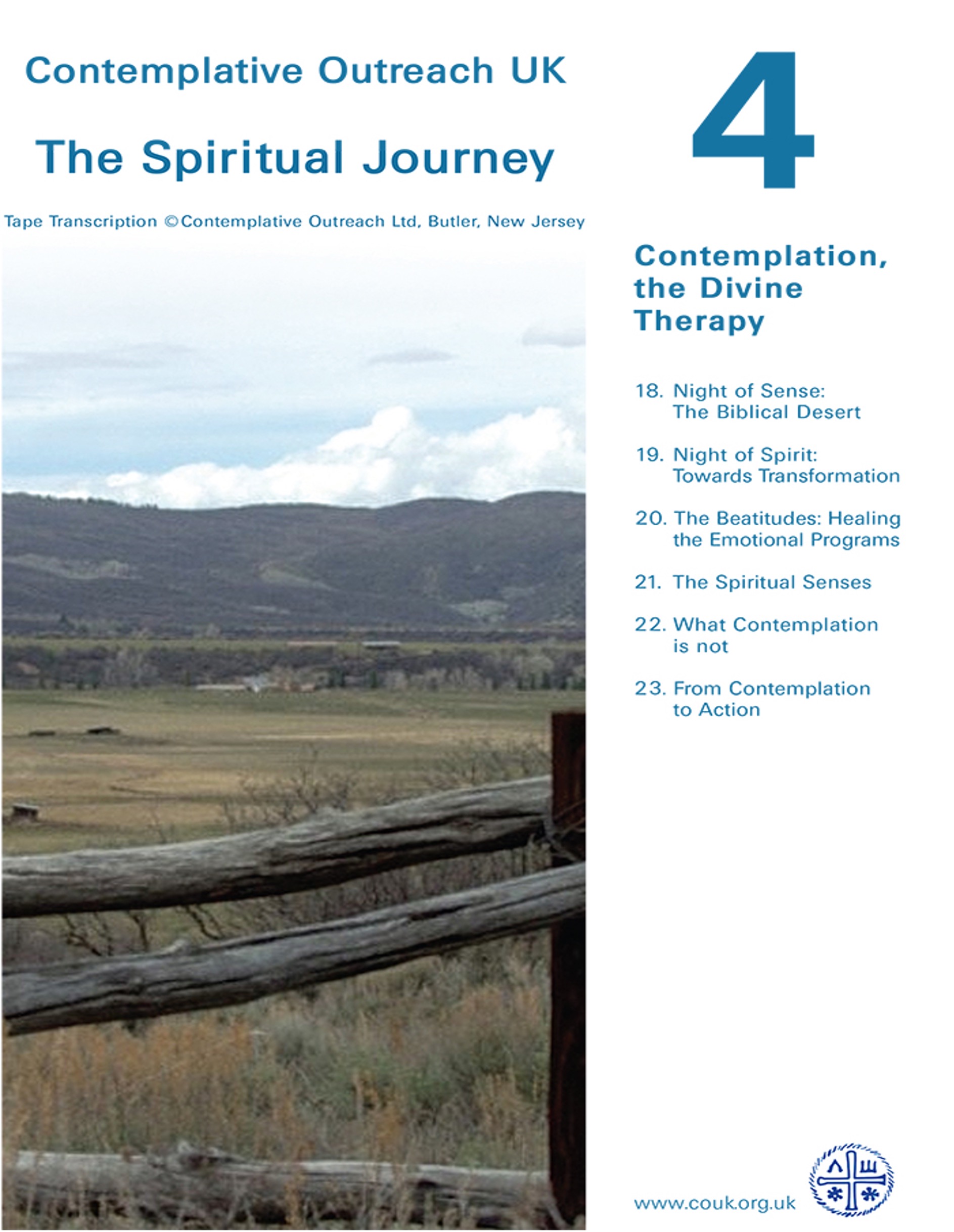
The transcripts contain the spoken words of Fr Thomas Keating from the Spiritual Journey Series in written format.

Each Booklet contains six written sections corresponding to that found on the DVDs, except for Part 5 which only has five sections.

Cheques payable to: Contemplative Outreach UK
Address:
10 Hawthorne Ave,
Higher Walton,
Preston,
PR5 4EE

OR

Pay by Bank Transfer:
Account Number: 84444108
Sort code: 40-37-25         
Ref: Transcript
BOOK SALE TO RAISE FUNDS FOR C.O.UK.

All books are as good as new, some as new. First come first served.
To reserve a book and to check it is still for sale email: infocouk@btinternet.com 

If the book is still available you will receive instructions on how to pay.
The books are only available to those in England, Scotland and Wales due to postal costs.

1. Silence: A User’s Guide. Maggie Ross. £7.00 incl. p+p.
 
2. Developing Consciousness. Nicholas Vesey. £7.00 incl. p+p
A Roadmap to Enlightenment.
 
3. Spiritual Passages. Benedict J. Groeschel. O.F.M. £6.50 incl. p+p
The Psychology of Spiritual Development.
 
4. Bridge across troubled Waters. Kess Frey £10.00 incl. p+p
Centering Prayer and the Theological Divide. (as new)
 
5. Centering Prayer by Basil Pinnington. O.C.S.O. £7.00 incl p+p 
(as new)
 
6. Experiencing God. Thomas Green. S. J. £5.00 incl. p+p
(as new)
 
7. Why not be a Mystic? Frank X Tuoti £9.00 incl. p+p
An irresistible invitation to experience the presence of God. 
(as new)
 
8. Seeking Spirituality – Ronald Rolheiser. £4.00 incl. p+p
(front cover ripped but mended) 
 
Books by Thomas Merton:

9. Seeds of Contemplation £6.00
(as new)

10. In Search of Solitude Journal Vol.3 1952-1960 £12.00
 (as new)

11. Seeds. selected and edited by Robert Inchausti (as new) £7.00
 (as new)

12.The Intimate Merton. His life from his Journals. hardback £14.00
(as new)
 
 PLEASE REMEMBER IN YOUR PRAYERS THE PEOPLE OF UKRAINE. 

Silence, Solitude, Solidarity, Service

Thomas Keating’s Experiment extracts from an article written by Thomas in 1993 

“I envisage Contemplative Outreach as an experiment to see if the fruit of the contemplative experience that I received in the monastery can be made available to people who are leading an ordinary life outside the monastery. It was not with a view to forming a community that we started. Rather we began in the usual way that retreats have been given for centuries.”

“My conviction grew that we could not introduce the contemplative life for people without some kind of on-going formation or support system. Actually, that was the original purpose of the primitive monastic life whether it was conscious or not.”

Observing the great influx of Eastern masters and the great attraction they had for young people in the 60’s and 70’s, a few of us at St. Joseph’s Abbey, Spencer, Massachusetts, USA, who were exposed to their wisdom, started asking ourselves whether it would be possible to put the contemplative monastic tradition into a form that ordinary people could understand and practice. Encouraged by the Vatican Council which urged the Church to try to express theology and Christian doctrine in modern terms and in contemporary language, it seemed to me that something similar should be done for spiritual theology and the contemplative tradition of the Church. It was then that Fr. William Menninger worked on a “how-to” method which was aimed at expressing the richness of the Cloud of Unknowing, by an unknown 14th Century author, in a form that would make it available to people in our day. Without some how-to method of contemplatively oriented prayer, people were being attracted in great numbers to the well thought out and well-presented methods of the Eastern masters who were arriving in increasing numbers in the USA. This was no passing fancy. It is estimated that ten thousand young people went to India every summer in search of spirituality and a guru, none of whom thought of inquiring at a Benedictine or Cistercian monastery about whether they could find a form of spirituality there.

The contemplative tradition was believed to be locked up in cloisters. Even there, it existed in  various truncated forms with an over -emphasis on monastic observances rather than on interior transformation. I felt that it was an acute situation that cried out for some response from the contemplative monks. Although we started off in the early 70’s imaging that it would be of interest to priests in active ministry and religious women, we did not envisage that it would be of much interest to lay people. They had been thoroughly convinced by their Catholic education that any aspiration for contemplative prayer could only be realised in a cloister. Thus, we saw the original movement toward contemplative prayer that had come from lay people looking for a structure that would be most helpful to support their spiritual aspirations, winding up over 

the centuries as the preserve of an institution with the unquestioned assumption that it could not be found anywhere except in a cloister, if indeed it could be found there.

This has left us in our time without a sense of the immense possibility that the Gospel opens out to lay peoples and indeed almost commands them to pursue. Evelyn Underhill is one of the outstanding mystics and writers on mysticism of our era. She offers a parable of the spiritual journey that might be apropos to repeat here. She wrote that the spiritual journey is like the migration of the English swallow, each weighing about an ounce and a quarter, who twice each year take off into the unknown, committing themselves to the air and flying over the ocean where there are no landmarks to give them guidance. And yet without any hesitation, every Fall, thousands of them and in spring return to England undergoing the same hazards. This journey she claims is a good example of what the spiritual journey is all about. We have no idea where we are going. There are all kinds of difficulties that we cannot foresee. The birds commit themselves to the elements by way of blind trust in their inner inspiration. The spiritual journey is basically a surrender to the inner conviction, that what we hope to find in the journey, we either already have or will certainly find. But there is no guarantee that we will get there on the basis of the evidence or our circumstances. We must let go and let the wind (the Holy Spirit )

Take us where we hope to go.

One of the reasons why contemplatives have always been in the minority in this world is because contemplation involves a surrender of one’s whole self, not just a period of time each day devoted to some form of prayer or meditation.   It is a commitment of immense proportions and hence it requires trust of an eminent character, faith that God will bring us where we  hope to go if we submit to this inner conviction or urging that we have to start. It does not matter how many difficulties there are, we have to go. There is no turning back once we have started because the atmosphere is a big place, and we had better stay with the flock. It is a movement of the Spirit rather than a movement of instinct as in the case of the Swallows.”

“ In the early days of teaching Centering Prayer, I perceived that people had to have some kind of adequate support system if they were going to persevere in the practice.”

“Naturally a lot of ordinary lay people stop when they get the message that Centering Prayer is not just a method of prayer that may provide a few months of peace before the real trials and difficulties begin. It requires dedication, hence some people are going to back out. It involves a commitment of the whole person, body, soul and spirit. Centering Prayer is totally in the service of sustaining us in a transformation process which is anything but secure, easy or certain.”

“I turned for a conceptual background to certain psychological paradigms because I think that very few seekers are going to start the spiritual journey today by reading the spiritual classics. I wonder if anyone would have started Centering Prayer f I had not put it into a psychological frame of reference that he or she could identify with. I don’t think the old classics are the way to start unless you are in a monastery where you have easy access to books.”

“The Christian Tradition has always been somewhat limited in methodology.”

“When I resigned from St. Joseph’s Abbey in 1981 and moved to St. Benedict’s Monastery, Snowmass, Colorado, I never intended to teach Centering Prayer. I got back into teaching Centering Prayer by being invited by the local pastor to give a course in something during the month of May 1982. Later an opportunity opened up to give a lengthy Intensive Retreat. I had always wanted to see what would happen to Christians if they meditated five or six hours a day. The retreat was a watershed. That experience convinced me that the same dynamics were available if Christians could be persuaded to do a form of non-conceptual prayer over a period of two weeks.

Anyone who does any kind of serious prayer practice has to have a conceptual background to explain it to themselves if not to other people. I knew that this need would be in great demand rather soon if people kept doing Centering Prayer. I tried to bring the Christian contemplative tradition in dialogue with contemporary science especially developmental psychology, anthropology and physics. I did not expect at first that anyone would be interested in it -certainly not lay persons. But I soon found out that lay persons were much more interested than the average priest or religious. I also became aware that people of other Christian denominations were interested too because they never had a contemplative tradition in their denominations (or at least not one for a very long) and they were beginning to feel the need of something. Many priests and bishops were beginning to question whether the way to reconvert people was to start with the Eucharist or Christian doctrine. Some kind of prayer experience looked a more promising way to begin.”

To be continued in the next Newsletter ……


MONDAY AFTERNOON – Weekly.

Every Monday at 3pm. Twenty minutes of Centering Prayer followed by a time for sharing and discussion. Normally finishes by 3:40pm. To participate send an email to Hugh Reid at hugh_reid2@yahoo.co.uk.


WEDNESDAY MORNING – fortnightly.

Wednesday Meeting
Fortnightly on Wednesdays at 11 am. Twenty minutes of Centering Prayer then space to share for those who wish until 11:45 am. Contact Elaine at elainewatson387@yahoo.co.uk.


WEDNESDAY AFTERNOONS – fortnightly.

Fortnightly on Wednesdays from 3:30 to 4:30. Twenty minutes Centering Prayer.
Followed by a discussion based on a chapter from Thomas Keating’s book, “Open Mind: Open Heart”.
To participate send an e-mail to David McCormick at davidfrancistssf@gmail.com.

THURSDAY AFTERNOON – fortnightly.

Fortnightly on Thursdays at 2pm. Twenty minutes of Centering Prayer. After the time of silence one of the ‘Guidelines for Christian Life, Growth, and Transformation’ from Thomas Keating’s book ‘Open Mind, Open Heart’ is read out. Participants then discuss the guideline. The meeting finishes at 3pm. 
To participate send an email to Sandra Ford at: sandra.ford32@gmail.com

THURSDAY EVENING – fortnightly.

Fortnightly on Thursdays from 7 pm till 8 pm. Twenty minutes of Centering Prayer followed by a discussion based on a chapter from Thomas Keating’s book ‘Open Mind, Open Heart’.
To participate send an email to David McCormick at davidfrancistssf@gmail.com.

A new Calendar page on the website will keep you updated on Zoom Groups and Events.

Contemplative Outreach Retreats. Due to the Pandemic, it is difficult to organise residential  retreats. 

The Formation for Contemplative Service has been successfully completed via Zoom. If you are interested contact infocouk@btinternet.com

Dawn

A gift,
An empty space
To retreat, 
To rethink, respond,
To recall, understand.

Stand still and listen,
The wind,
The voice of the trees, 
Words of love
You should have spoken,
Pathways still to follow.

Stand still and listen again,
To the silence
You have yet to hear,

The song,
The blackbird,
The dawn.

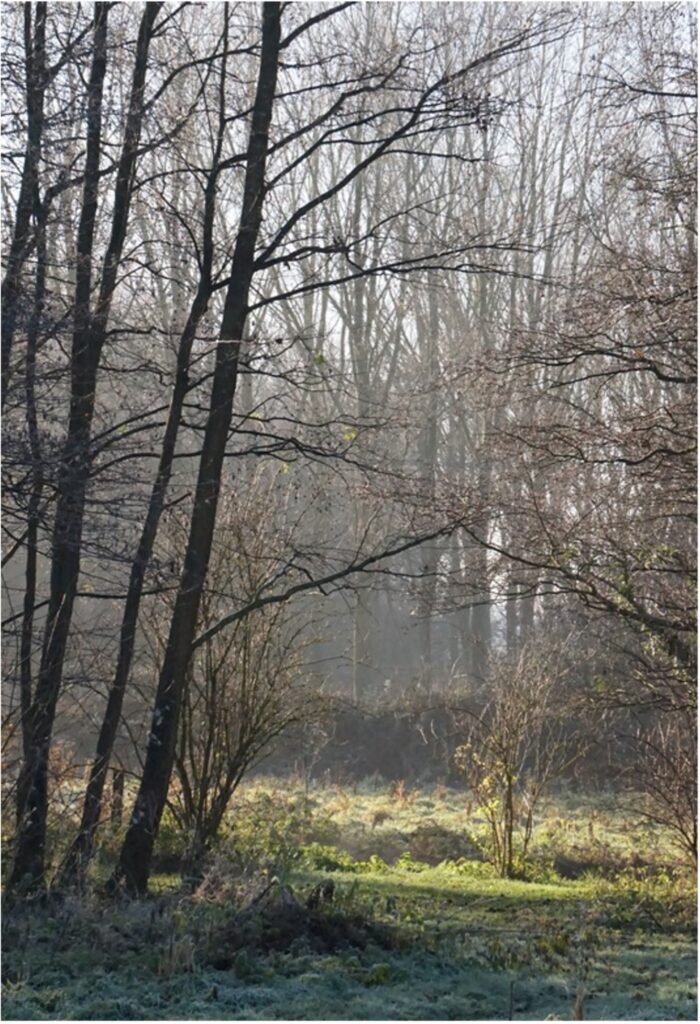
Poem and picture by Chris Roe.

“I am not bound by thought or sense or shape:
I live in the glory of the Infinite.
I am near to the Nameless and the Unknowable,
The ineffable is now my household mate.”

Savitri


Irene’s Updates.

The Spiritual Journey – Formation in the Christian Contemplative Life.
This e-course which was available from Contemplative Outreach Ltd on
the Spirituality and Practice website, is now being offered for free on the CO website.

News of Centering Prayer in mainland Europe.

On Sunday 7th November it was a great pleasure to talk with Kirsti, Sirkku and Kristel via Zoom. Like all of us the Pandemic has affected what they have been able to do. Estonia has been particularly hit hard by the pandemic. Sirkku and Kirsti have done a  two week retreat together. Kirsti is talking with someone from a silent prayer group in a day or two. Sirkku is planning a two-year training course.

To remind you,

  • Kirsti lives in Oslo, Norway 
  • Sirkku lives in Tuusula, Finland and will be introducing Centering Prayer in her area. Sirkku also will be translating the teaching into Finnish.
  • Kristel Ehala-Aleksejev lives in Tallinn, Estonia and will be introducing Centering Prayer in her area. Kristel with the help of Sirkku will be translating the teaching into Estonia.

We will have another Zoom Meeting in six months. 

If you have news of any other groups in mainland Europe, please email infocouk@btinternet.com with the information. Thank you.

The transcript is sold by Contemplative Outreach UK.
£12.50 incl. p + p.  UK. only.

You can also email for more information – infocouk@contemplative-outreach-ukThey are also available from – Elizabeth Smith,10 Hawthorne Ave, Higher Walton. PRESTON, PR5 4EE
We have more on our website click HERE to go to our site.

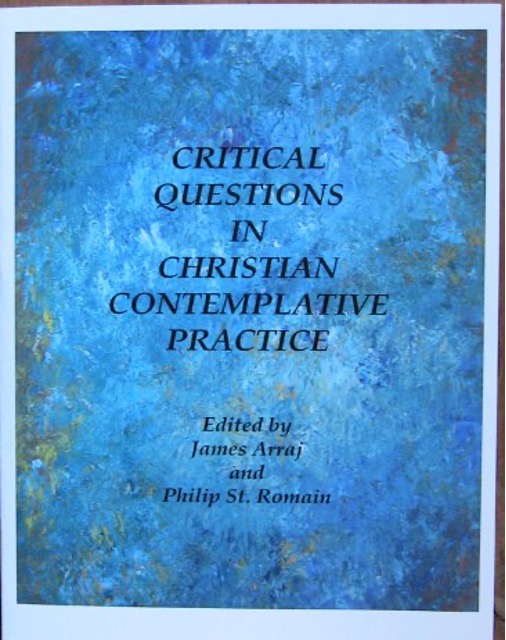
Both Philip and James are married with children and live in the USA
James Arraj is a Jungian psychologist. He has written a number of books on psychology and spirituality. 
Philip St Romain is an author, spiritual director, and retreat leader.
 
Kindle edition £5:20
Part 1 introduces us to three modern attempts to renew the Christian life of prayer.
 
Part 2 allows us to meet people today who have had Christian experiences of prayer and contemplation.
 
Part 3 explores how the renewal of the Christian contemplative life is interacting with Eastern forms of meditation.
 
The wide-ranging debates found here are the result of the Christian mystical tradition trying to wake up and throw off the torpor of a sleep that has lasted more than 300 years. And the most amazing thing about these discussions is that they are taking place in a new context which is not a theoretical theological analysis of the spiritual life, but among people who are concerned with how one would go about living the contemplative life day by day, and who are actually trying to do it. In short, we face the first sustained practical interest in contemplation since the end of the 17th century, but already this enthusiasm has raised critical questions that need to be addressed lest these new beginnings go astray.

The material here came originally from www.shalomplace.com and www.innerexplorations.com

Our Address