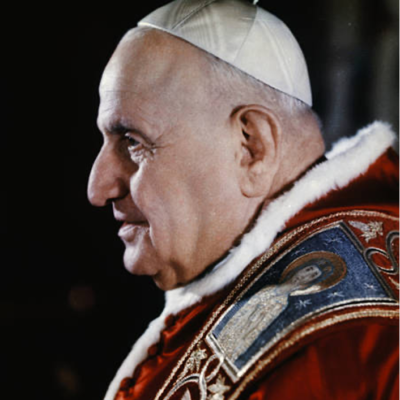
Pope John XXIII.
Peace on Earth
One of the programmes I recently watched on the Television was on the late Pope John XXIII. The programme inspired me to write the following article.
On 11th April 1963 Pope John XXIII signed his last Encyclical before his death. It was entitled, “On Establishing Universal Peace in Truth, Justice, Charity and Liberty. In short “Peace on Earth” derived from the opening words of the Encyclical. The full sentence reads,
“Peace on earth, for which all men of every era have most eagerly yearned, cannot be firmly established unless the order which God laid down is dutifully observed”.
It was the first Encyclical that a Pope addressed to “all men of good will”, rather than only to Catholics. Some have interpreted this to mean he was insisting that the responsibility for setting conditions for peace does not belong to the great and powerful of the world – it belongs to each and every one of us.
In this Encyclical Pope John states that conflicts,
“should not be resolved by recourse to arms, but rather by negotiation”. The Encyclical also clearly says, “that everyman has the right to life, to body integrity and to the means which are suitable for the proper development of life”.
Pope Francis in 2019 on a visit to Bulgaria invoked the Encyclical as a “code of conduct” for peace between Catholic and other religions.
As this year of 2021 begins let us take up these thoughts and renew and deepen our practice of Centering Prayer towards establishing Peace on Earth.
If you have time it is worth reading this Encyclical from Pope John XXIII, though you need to remember the language maybe outdated the insightful person will recognise the sentiments which we still need in 2021. Pope John was expected to continue in the traditional way of Pope Pius XII. He surprised everyone by calling a Council for the first time in a hundred years for the Catholic Church to look at itself and renew itself. Vatican II. It may seem that something from the 1960’s will have nothing to say to us in 2021. It speaks clearly to the problems of today.
• The first section establishes the relationship between individuals and humankind, encompassing the issues of human rights and moral duties.
• The second section addresses the relationship between man and state, dwelling on the collective authority of the latter.
• The third section establishes the need for equality amongst nations and the need for the state to be subject to the rights and duties that the individual must abide by.
• The final section presents the need for greater relations between nations, thus resulting in collective states assisting other states. The encyclical ends with the urging of Catholics to assist non-Christians and non-Catholics in political and social aspects.